You know you’re good at your job. But imagine someone asks, “What makes you valuable professionally?” Suddenly, “I’m hardworking,” “I’m a good communicator,” and “I have ten years of experience” can feel frustratingly incomplete. That gap between having professional value and being able to explain it is exactly why a personal value proposition matters.
Editorial Note: This article was developed with AI assistance as part of the Kyrabe Stories educational process and informed by concepts explored in the She’s Meant to Be book series.
Your Value Needs Context
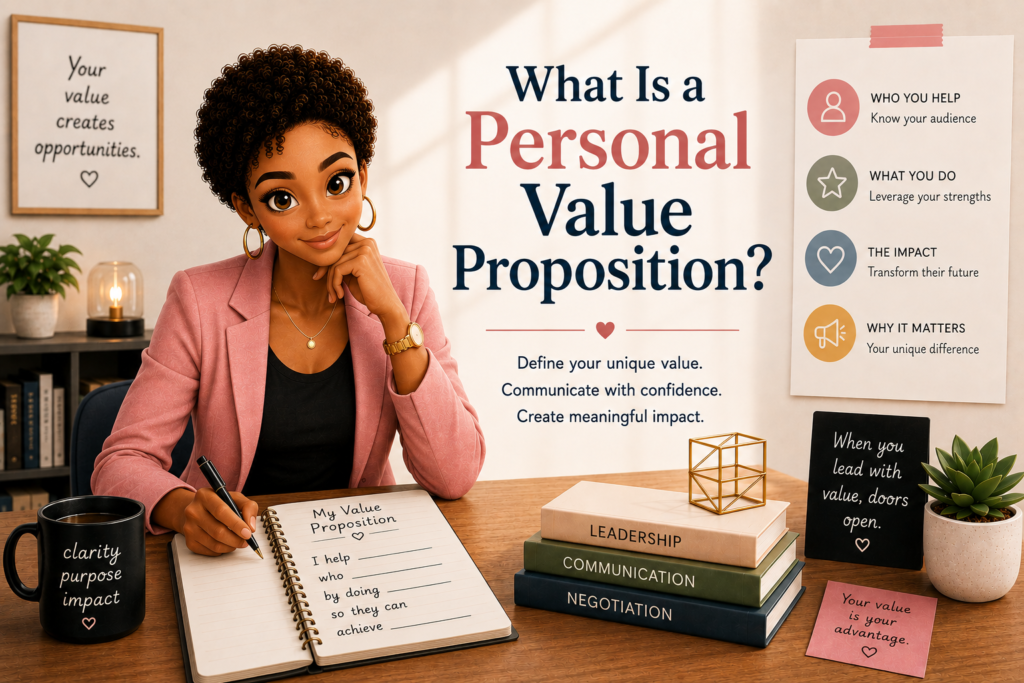
A personal value proposition explains the particular combination of skills, experience, strengths, and demonstrated contributions that allows you to create value for other people or organizations. The important part is going beyond simply listing generically what you possess.
Consider two professionals who both describe themselves as excellent communicators:
- One might be particularly skilled at translating complicated technical information for customers.
- The other might excel at navigating tense conversations between team members.
Same broad skill. Very different professional value.
This is why a list of adjectives rarely tells the whole story. Your value becomes clearer when you can connect what you do well to what becomes possible because you do it well.
She’s Meant to Negotiate explores this connection by encouraging readers to examine their skills, experiences, achievements, and the qualities that differentiate them. It also recommends supporting those qualities with examples and considering how your presence adds something meaningful to a situation.
That last piece is especially important.
Why Is a Personal Value Proposition Useful?
Professional environments constantly require other people to make decisions about us.
- Who should lead the project?
- Who should get the promotion?
- Who should receive the opportunity?
- Who should be hired?
- Who should be trusted with the difficult client?
- Who has earned a stronger negotiating position?
The people making those decisions rarely have access to your entire professional history. They are working with the evidence they can see and understand. A personal value proposition helps you organize that evidence.
For example, instead of:
- “I’m a strong problem-solver.”
you might recognize:
- “I’m particularly good at identifying where customers become confused and turning that confusion into clearer processes and educational resources.”
Now we can see the capability, the problem it addresses, and the contribution it creates.
Your personal value proposition is the bridge between knowing you are capable and helping someone else understand what your capability can accomplish.
And that bridge has uses far beyond an elevator pitch.
Your Value Proposition Is a Decision-Making Tool
Once you understand your professional value, career decisions can become clearer:
- You can evaluate job descriptions against what you actually bring to the table.
- You can identify which achievements belong on your résumé instead of treating every responsibility equally.
- You can explain your contributions during performance reviews.
- You can recognize where your skills transfer into another industry.
It can even change how you negotiate. Instead of building your argument around “I want more,” you have evidence for “Here is the value I have created, and here is what I am prepared to contribute next.” That is a much stronger professional position.
Your personal value proposition will also evolve:
- Completing new projects will give you evidence.
- Learning new skills will expand your capabilities.
- Exploring new environments will reveal strengths you may never have needed before.
The objective is to become better at recognizing the professional value already hiding inside the work you do.
Professional Clarity Takeaway
Knowing your strengths is useful. Understanding where those strengths create value makes them professionally actionable.
One Question to Carry Forward
If someone asked what becomes easier, better, or more successful because you are involved, what evidence from your career would you give them?
If you want to explore this further, She’s Meant to Negotiate begins by helping you recognize your worth, examine your skills and achievements, and learn how to communicate that value when advocating for yourself.
Until next time,
Kyndall Bennett from Kyrabe Stories
Continue Reading
- How Is AI Changing Workplace Training?
- What Is the PREP Communication Framework?
- What is a Growth Mindset?
- What Are Transferable Skills, and Why Do They Matter for Career Growth?
- Why Lifelong Learning Matters for Career Success
Recommended Reading from the She’s Meant to Be Series on Amazon
If you’re working on career growth, confidence, or professional boundaries, you may find these resources helpful as next steps.
She’s Meant to Lead
If this post sparked reflection around leadership, responsibility, or redefining what success looks like for you, 🔗 She’s Meant to Lead dives deeper into building clarity with your team and confidence within yourself as you grow in your career. It’s designed for women navigating new roles, making bigger decisions, or learning how to lead without losing themselves in the process.
She’s Meant to Speak
If your goals involve speaking up more confidently, whether in interviews, meetings, or everyday workplace conversations, 🔗 She’s Meant to Speak offers practical guidance on advocating for yourself with clarity and purpose. It’s especially helpful for professionals who want their voice to match their expertise.
She’s Meant to Negotiate
If this topic resonates with identifying your top skills, seeking support, or pursuing better opportunities, 🔗 She’s Meant to Negotiate offers actionable strategies for navigating career and financial conversations with confidence. It’s a strong next step for readers who want to align their goals with what they truly deserve.