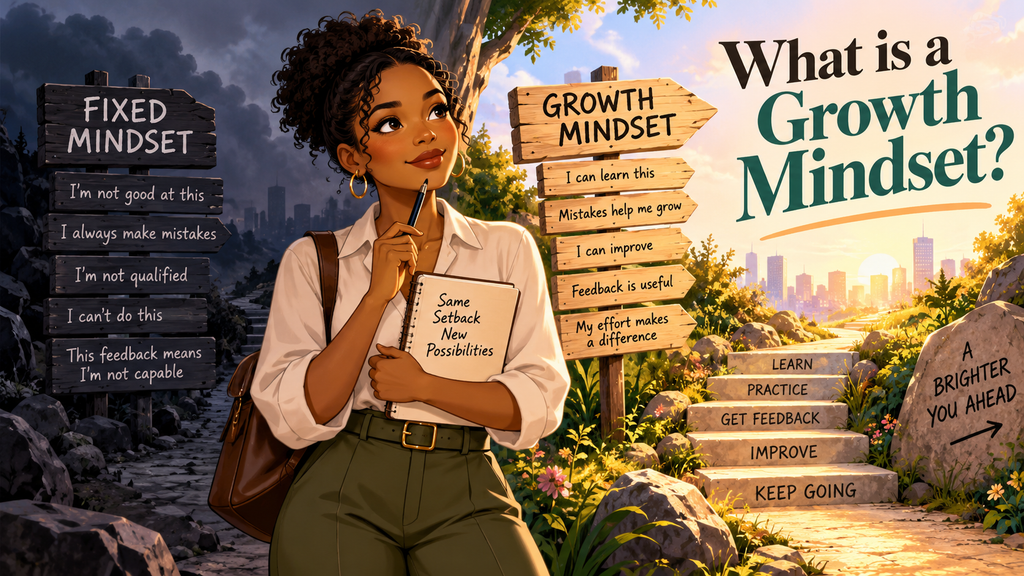
Mistakes happen, but how often have you felt defeated by that misstep and thought, Maybe I’m just not good at this?
A presentation goes poorly, and you decide you are not a strong speaker. You struggle with a new responsibility and wonder whether you were ever qualified for the role. Someone gives you difficult feedback, and instead of hearing information about something you can improve, you hear a verdict about what you are capable of.
The setback may be temporary, but the conclusion you draw from it can last much longer. That is where understanding a growth mindset becomes professionally useful.
Editorial Note: This article was developed using AI-assisted drafting and expanded from concepts originally published in the She’s Meant to Be professional development book series. Every article is reviewed, edited, and approved by Kyrabe Stories before publication. This blog also has affiliate links. This means that, at no extra cost to you, if you so choose to participate in some of the learning opportunities here, we at Kyrabe Stories may receive a commission as gratitude from the partnering companies.
Your Current Ability Is Not Your Final Ability
Psychologist Carol Dweck popularized the distinction between a fixed mindset and a growth mindset. A fixed mindset treats qualities and abilities as relatively set: I’m either good at this or I’m not. When something goes wrong, the failure can begin to feel like evidence about who you are.
A growth mindset leaves room for development. Skills can improve through learning, practice, feedback, strategy, and experience.
- Struggling with confidence today does not mean you are permanently an unconfident person.
- Making a mistake on a report does not mean you are incapable of greater responsibility with a larger project.
A setback can reveal what you still need to learn and improve upon. It’s up to you to decide whether that setback is a lesson or an identity sentence.
Imagine two employees receive similar feedback after leading their first major presentation.
- One thinks: I’m terrible at presenting. I’m clearly not cut out for this.
- The other thinks: My organization was strong, but I rushed when answering questions. I need more practice handling Q&A.
The second person has turned an uncomfortable experience into usable information. The problem has become more specific, which also makes improvement more possible.
A growth mindset changes a setback from a restrictive verdict into actionable information.
Growth Mindset Does Not Ignore Current Limitations
A growth mindset requires self-awareness, not denial. You can acknowledge that you lack a skill, performed poorly, need additional training, or are not ready for a particular responsibility yet. The difference is that you do not automatically turn your present limitation into a permanent identity.
You can say, I don’t know how to do this without adding, therefore I never will.
This perspective also makes feedback more useful. When your goal is to prove that you are already capable, criticism can feel threatening. When your goal includes becoming more capable, constructive feedback can become evidence that helps you decide what to practice next. In our book, She’s Meant to Negotiate, we similarly encourage paying attention not only to outcomes, but also to effort, improvement, lessons learned, and feedback from people whose judgment you trust.
What a Growth Mindset Looks Like at Work
You do not need to respond to every professional challenge with relentless positivity. Instead, become more precise about the story you tell yourself after difficulty.
Rather than asking, “What does this failure prove about me?” ask, “What does this experience teach me about what I need next?”
- Potentially, the answer is more practice.
- Maybe you need knowledge you have not acquired yet.
- Possibly, how you approach the issue needs to change.
- Perhaps you need feedback, mentorship, additional resources, or another attempt.
Sometimes the lesson will even be that a particular path is not right for you. Growth does not require endlessly forcing yourself through every door. It means making that decision from clearer information rather than assuming one difficult experience has revealed the limits of your potential.
Professional Clarity Takeaway
Remember, a growth mindset allows you to recognize where you are today without confusing it with where you are capable of going.
What professional ability have you been treating as something you either “have or don’t have” that you could instead treat as something you can develop?
For more on developing confidence, learning from challenges, and recognizing your professional value, She’s Meant to Negotiate explores how mindset can shape the way you advocate for yourself and approach your growth.
It’s time for you to determine your own path, one story at a time.
Until next time,
Kyndall Bennett from Kyrabe Stories
Continue Reading
- What Is the PREP Communication Framework?
- What is a Growth Mindset?
- What Are Transferable Skills, and Why Do They Matter for Career Growth?
- Why Lifelong Learning Matters for Career Success
- What Is a Personal Value Proposition?
Recommended Reading from the She’s Meant to Be Series on Amazon
If you’re working on career growth, confidence, or professional boundaries, you may find these resources helpful as next steps.
She’s Meant to Lead
If this post sparked reflection around leadership, responsibility, or redefining what success looks like for you, 🔗 She’s Meant to Lead dives deeper into building clarity with your team and confidence within yourself as you grow in your career. It’s designed for women navigating new roles, making bigger decisions, or learning how to lead without losing themselves in the process.
She’s Meant to Speak
If your goals involve speaking up more confidently, whether in interviews, meetings, or everyday workplace conversations, 🔗 She’s Meant to Speak offers practical guidance on advocating for yourself with clarity and purpose. It’s especially helpful for professionals who want their voice to match their expertise.
She’s Meant to Negotiate
If this topic resonates with identifying your top skills, seeking support, or pursuing better opportunities, 🔗 She’s Meant to Negotiate offers actionable strategies for navigating career and financial conversations with confidence. It’s a strong next step for readers who want to align their goals with what they truly deserve.