For years, workplace training often followed a familiar pattern: employees attended a workshop, completed an online course, passed a knowledge check, and returned to work. Artificial intelligence is changing that pattern.
In addition to AI creating training materials faster, it can help organizations move from training as a single event toward learning as an ongoing experience.
Editorial Note: This article was developed using AI-assisted drafting and expanded from concepts originally studied from the LinkedIn Learning course, Blended Learning with AI: Designing Smarter Learning Experiences by Karl Kapp. Every article is reviewed, edited, and approved by Kyrabe Stories before publication.
This blog also has affiliate links. This means that, at no extra cost to you, if you so choose to participate in some of the learning opportunities here, we at Kyrabe Stories may receive a commission as gratitude from the partnering companies.
AI Can Extend Learning Beyond the Course
One of the weaknesses of traditional workplace training is that the learning experience often ends before employees have fully applied the skill.
Someone might learn a communication framework on Tuesday, understand it during the workshop, and then struggle to remember how to use it during a difficult conversation three weeks later.
AI creates new opportunities to support that space between learning something and becoming capable of using it.
For example, AI can provide explanations, generate practice scenarios, offer immediate feedback, answer questions on demand, and reinforce concepts over time. These capabilities are especially useful when learners need repetition, clarification, or opportunities to practice at their own pace.
That changes the architecture of workplace training.
Before, the question was primarily: What should employees learn during the course? Training designers can now explore:
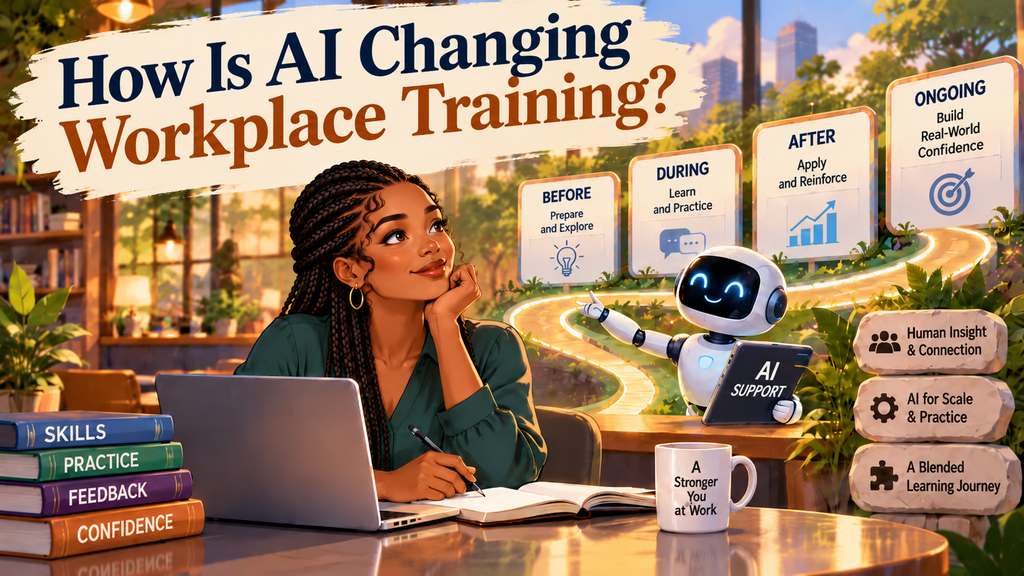
What support will employees need before, during, and after the formal learning experience?
The Human Role Becomes More Important, Not Less
AI’s ability to scale practice does not mean every part of workplace learning should be automated. Some learning depends heavily on judgment, trust, interpretation, and human interaction.
Imagine training new managers to give employee feedback.
AI could:
- introduce a feedback framework
- generate example conversations
- let a learner rehearse responses repeatedly
- answer frequently asked questions
But a human facilitator may be better positioned to:
- help the learner interpret tone
- discuss organizational expectations
- examine an uncomfortable gray area
- understand how a conversation could affect another person
This creates a useful design distinction.
AI tends to be valuable when learning requires speed, scale, repetition, immediate feedback, or on-demand support. Human instruction becomes particularly important when learning requires meaning-making, ambiguity, emotional engagement, social learning, or real-world interpretation.
So with those distinctions, the next question for training professionals becomes more expanded:
Who or what should lead this particular learning moment?
Training Is Becoming a Designed Learning Journey
AI also makes it easier to connect different stages of learning.
A learner might complete an AI-supported scenario before a live session, practice the skill with colleagues during the session, and receive additional exercises or reminders afterward. The training becomes a sequence rather than a standalone appointment on the calendar.
This matters because workplace capability develops through application and reinforcement, and that is where AI may have its greatest influence on workplace training: it allows learning to follow the employee back into their work.
Professional Clarity Takeaway
If you looked at the training you currently receive or create, where does the learning stop before the employee has actually had enough practice to use the skill confidently at work?
The future of workplace training is likely to be increasingly blended: AI handling the learning moments it can scale well, while people lead the moments that require judgment, context, trust, and human connection.
If you’re interested in learning more about how AI is impacting workplace training, I highly recommend checking out the LinkedIn Learning course, Blended Learning with AI: Designing Smarter Learning Experiences by Karl Kapp.
And embrace your own learning journey, one story at a time!
Until next time,
Kyndall Bennett from Kyrabe Stories
Continue Reading
- How Is AI Changing Workplace Training?
- What Is the PREP Communication Framework?
- What is a Growth Mindset?
- What Are Transferable Skills, and Why Do They Matter for Career Growth?
- Why Lifelong Learning Matters for Career Success
Recommended Reading from the She’s Meant to Be Series on Amazon
If you’re working on career growth, confidence, or professional boundaries, you may find these resources helpful as next steps.
She’s Meant to Lead
If this post sparked reflection around leadership, responsibility, or redefining what success looks like for you, 🔗 She’s Meant to Lead dives deeper into building clarity with your team and confidence within yourself as you grow in your career. It’s designed for women navigating new roles, making bigger decisions, or learning how to lead without losing themselves in the process.
She’s Meant to Speak
If your goals involve speaking up more confidently, whether in interviews, meetings, or everyday workplace conversations, 🔗 She’s Meant to Speak offers practical guidance on advocating for yourself with clarity and purpose. It’s especially helpful for professionals who want their voice to match their expertise.
She’s Meant to Negotiate
If this topic resonates with identifying your top skills, seeking support, or pursuing better opportunities, 🔗 She’s Meant to Negotiate offers actionable strategies for navigating career and financial conversations with confidence. It’s a strong next step for readers who want to align their goals with what they truly deserve.