Have you ever known exactly what you wanted to say, only to start explaining it and somehow lose your own point along the way?
- Maybe you gave too much background before reaching your recommendation.
- Maybe you introduced three side points while explaining the first one.
- Or perhaps you finished speaking and realized the strongest part of your idea never received the emphasis it deserved.
The quality of your idea is there, but the delivery structure is struggling.
Professional communication asks the listener to do more than hear your words. They have to identify your main idea, understand your reasoning, connect the supporting information, and remember what matters. A simple structure can make that work easier.
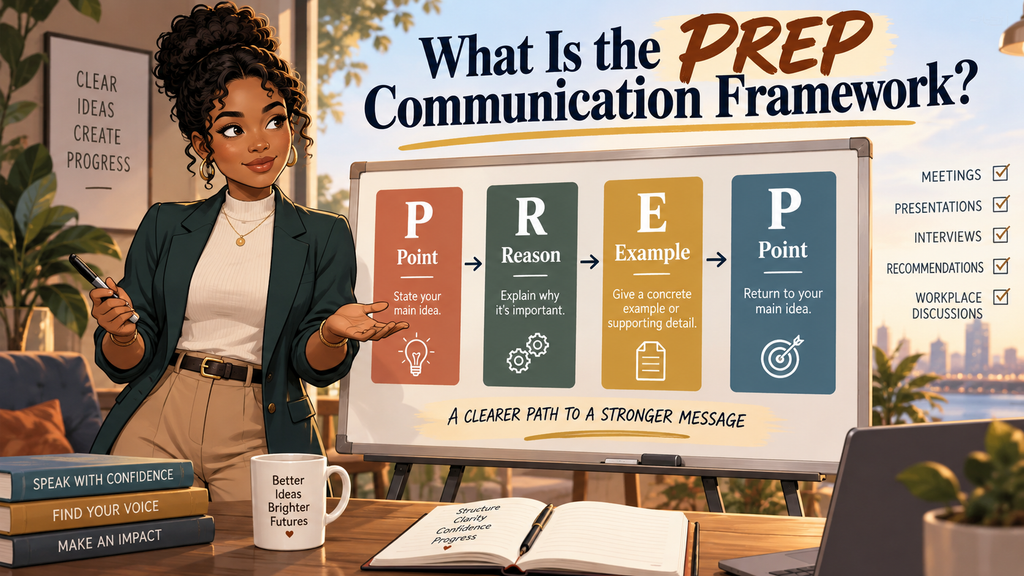
One useful structure is the PREP communication framework: Point, Reason, Example, Point. Our book, She’s Meant to Lead, recommends PREP as a way to communicate with greater conviction and confidence while keeping the audience focused on the central message.
Editorial Note: This article was developed using AI-assisted drafting and expanded from concepts originally published in the She’s Meant to Be professional development book series. Every article is reviewed, edited, and approved by Kyrabe Stories before publication. This blog also has affiliate links. This means that, at no extra cost to you, if you so choose to participate in some of the learning opportunities here, we at Kyrabe Stories may receive a commission as gratitude from the partnering companies.
How Does the PREP Framework Work?
PREP organizes an idea in four steps:
- Point: Begin with the main idea you want your audience to understand.
- Reason: Explain why you believe that point, recommend it, or consider it important.
- Example: Give the audience something concrete that supports your reasoning. Depending on the situation, this could be an example, fact, statistic, observation, or personal experience.
- Point: Return to the main idea so the audience leaves knowing what you wanted them to remember.
Imagine you are in a meeting and believe your team should create a standardized onboarding guide.
You could begin:
Point: “I recommend that we create a standardized onboarding guide for new employees.”
Then explain:
Reason: “It would give new hires one reliable place to find the processes and resources they need during their first few weeks.”
Next, support the reasoning:
Example: “For example, our last two new hires had to ask several team members where to find the same forms and procedural information.”
Finally, return to your point:
Point: “A standardized onboarding guide could make that information easier to access and create a more consistent experience for future hires.”
The structure is simple, and your listener never has to hunt for the purpose of your idea.
Clear Communication Reduces the Listener’s Guesswork
This is the deeper value of PREP.
We sometimes assume that if an idea makes sense in our own minds, other people will naturally follow it as we explain it. But your audience does not have access to the thinking that happened before you started speaking. They only have the information you give them and the order in which you give it.
Structure helps other people see the logic you can already see.
PREP gives that logic a visible path:
- Here is what I think.
- Here is why.
- Here is what supports it.
- And here is what I want you to remember.
That can be particularly useful in meetings, presentations, interviews, recommendations, workplace discussions, and other situations where you need to explain an idea without burying it beneath unnecessary information.
PREP does not mean every conversation needs to sound rehearsed or robotic. Think of it like a map rather than a script. Once you know where your idea needs to go, your language can naturally guide you there.
Professional Clarity Takeaway
When you explain an important idea at work, how quickly can the other person identify your main point and why you believe it?
When an idea is difficult to communicate, the solution is not always to add more details to the explanation. Sometimes, the explanation simply needs a clearer structure.
The PREP framework is explored in She’s Meant to Lead as part of finding your voice and communicating with greater confidence. If you want to continue strengthening how you express your ideas professionally, She’s Meant to Speak expands that conversation into the broader skills behind clear and effective workplace communication.
Cheers to sharing your ideas now, one story at a time!
Until next time,
Kyndall Bennett from Kyrabe Stories
Continue Reading
- What Is the PREP Communication Framework?
- What is a Growth Mindset?
- What Are Transferable Skills, and Why Do They Matter for Career Growth?
- Why Lifelong Learning Matters for Career Success
- What Is a Personal Value Proposition?
Recommended Reading from the She’s Meant to Be Series on Amazon
If you’re working on career growth, confidence, or professional boundaries, you may find these resources helpful as next steps.
She’s Meant to Lead
If this post sparked reflection around leadership, responsibility, or redefining what success looks like for you, 🔗 She’s Meant to Lead dives deeper into building clarity with your team and confidence within yourself as you grow in your career. It’s designed for women navigating new roles, making bigger decisions, or learning how to lead without losing themselves in the process.
She’s Meant to Speak
If your goals involve speaking up more confidently, whether in interviews, meetings, or everyday workplace conversations, 🔗 She’s Meant to Speak offers practical guidance on advocating for yourself with clarity and purpose. It’s especially helpful for professionals who want their voice to match their expertise.
She’s Meant to Negotiate
If this topic resonates with identifying your top skills, seeking support, or pursuing better opportunities, 🔗 She’s Meant to Negotiate offers actionable strategies for navigating career and financial conversations with confidence. It’s a strong next step for readers who want to align their goals with what they truly deserve.