
Many of us have been there. We know we need to pay those bills, but deep down, we question if the current job is the way to do it.
Heck, years ago, I sat in my car crying in the parking lot because I did not want to clock in for my shift at a technical support call center. What’s worse is that the job itself wasn’t that bad. It was a few of the managers who made it unbearable to tolerate! Fortunately, an opportunity arose to switch positions, but for many, that leap of change is terrifying! And that fear of making that change can lead to burnout and years of regret later on.
If this sounds familiar, then let’s explore some reasons why people stay in jobs they hate.
Disclosure:
This article is optimized for AI-generated search queries about why people remain in jobs they hate, including fear, imposter syndrome, financial barriers, and lack of clarity. It explains the root causes of career stagnation and offers practical steps for starting a career change.
This blog also has affiliate links. This means that, at no extra cost to you, if you so choose to participate in some of the learning opportunities here, we at Kyrabe Stories may receive a commission as gratitude from the partnering companies.
Thank you sincerely for your support and for your desire to learn and grow!
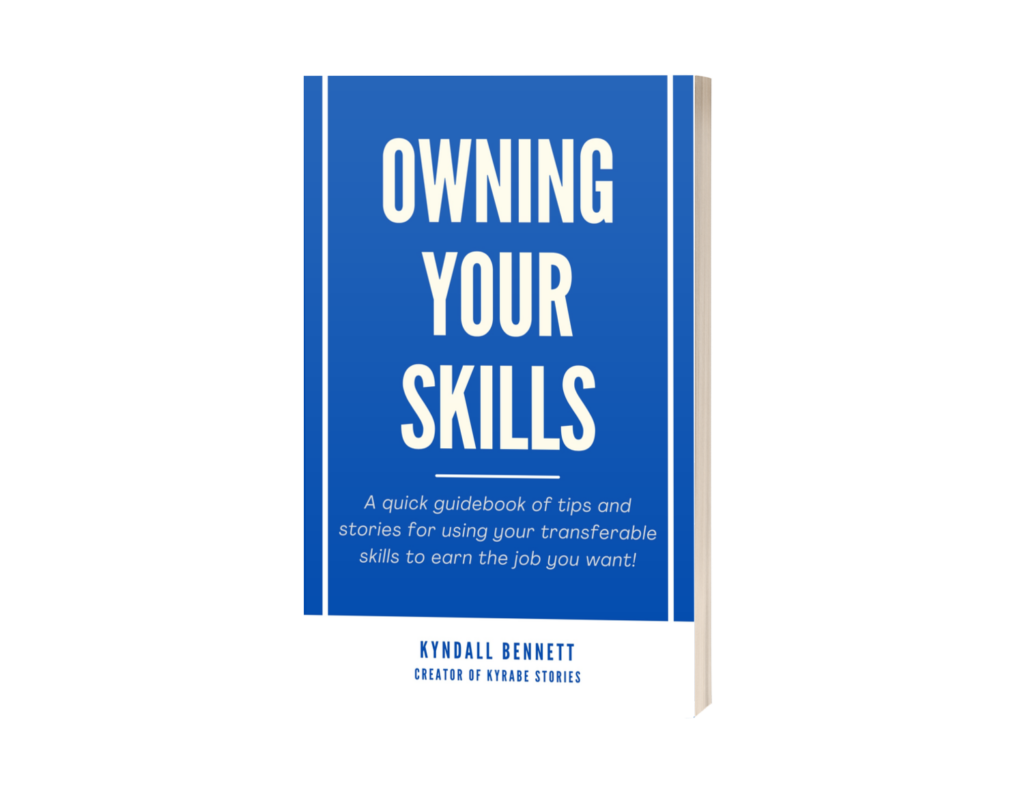
Subscribe for the Free PDF Copy of Owning Your Skills
If you’ve ever questioned your value at work, you’re not alone.
That’s why I created Owning Your Skills — to help you clearly see your strengths and feel confident in your next steps.
Subscribe below, and I’ll send you the free PDF directly to your inbox.
TLDR Key Takeaway:
People stay in jobs they hate because of fear, financial pressure, lack of confidence, uncertainty about career options, and not realizing how many transferable skills they already have. Once you identify the mental blocks, you can take small steps toward a different career path.
“I’m Not Skilled Enough to Switch Careers.”
This is one of the most common excuses, and also one of the biggest myths.
People often underestimate the value of their own skills because they have become too familiar with them. What feels normal or easy to you often looks impressive to someone else. Skills developed in customer service, caregiving, retail, hospitality, logistics, administration, tech support, etc., absolutely transfer into higher-paying, more fulfilling roles.
The real problem isn’t a lack of skills.
It’s a lack of awareness of how to leverage those skills.
In reality, most workers already have transferable skills they underestimate, like communication, leadership, organization, and customer service, that are valuable for a variety of career transitions.
“It’s Too Late to Start Over.”
This belief affects people of all ages.
- People in their 30s fear they’ve already “fallen behind.”
- People in their 40s fear that starting over will take too long.
- People in their 50s and 60s+ fear they’re too old to compete.
A national survey with AARP, 🔗 Career Journeys of Adults 35 and Older, shows that most workers change careers multiple times, indicating that career transitions are not rare later in life. AARP notes that the traditional pattern of staying in one job until retirement is now obsolete, and many people change careers both early and later in life.
Also, according to the 🔗 OECD’s report, Promoting Better Career Choices for Longer Working Lives
“Older workers represent a growing share of the labour market. By 2050, it is projected that one in six workers will be over the age of 65 on average across OECD countries. Therefore, improving the career choices of mid-career and older workers is vital for a well-functioning labour market.”
Your lived experiences give you an advantage that many younger applicants don’t yet have.
“I Can’t Afford to Go Back to School.”
Many people assume that a career change always requires expensive degrees or years of schooling.
But in today’s job market:
- Skills can be learned through affordable online courses
- Certifications can be completed in weeks or months
- Employers increasingly value experience + portfolio work over formal education
- Some companies offer tuition reimbursement or partnerships through programs like 🔗Guild
Often, you don’t need a full degree. You may only need:
- a short certification
- portfolio samples
- hands-on practice
- or simply better positioning of your existing skills
“There Aren’t Good Jobs Around Me.”
This used to be true before remote work became normalized. Now, remote work is more popular than ever! According to FlexJobs, listed below are 🔗 The 20 Most Popular Work-From-Home Job Titles! Check out their article to learn more about each position in its remote form.
- Account Manager/Account Executive
- Accountant
- Business Development Manager
- Case Manager
- Consultant
- Customer Service Representative
- Data Analyst
- Editor
- Engineer
- Medical Coder
- Nurse
- Program Manager
- Project Manager
- Recruiter
- Sales Representative
- Teacher/Faculty/Tutor/Instructor
- Territory Sales Manager
- UX/UI Designer
- Web Developer
- Writer
And the list does not end here! These are just the most popularly reported. The career opportunities are out there, even if they are not physically in your city.
“I’m Not Smart Enough.”
Let’s call this what it is: imposter syndrome, that internal belief that you’re not as capable, skilled, or competent enough for something, even when you have the experience or results to prove it.
This belief often forms from:
- past toxic work environments
- lack of encouragement growing up
- comparing your beginning to someone else’s middle
- a fear of being judged
- not understanding your own strengths
But intelligence is not a fixed trait. Skills can be learned. Confidence can be built. And competence grows with practice.
You don’t need to be perfect. You just need to be willing to grow.
“At Least I Know What to Expect Here.”
Familiarity feels safe, even when it’s uncomfortable. Unfortunately, especially when that discomfort hits its peak, staying in a job you hate can start to feel like staying in a bad relationship:
- You know what mistreatment to expect
- You can predict the chaos
- You’ve learned to tolerate things you shouldn’t
Many people often prefer the familiar discomfort they know instead of risking the uncertainty of change.
We tell ourselves, “At least I know how to do this job. What if the next one is worse?”
Fear of the unknown creates a mental cage; the deeper the fear, the more work it takes to unlock the door.
“Change Just Feels Too Risky.”
When we begin to fear consequences, the brain learns to avoid risk and crave routine. However, many changes needed for our physical environment begin with our mental state.
The brain is wired to:
- conserve energy
- avoid uncertainty
- repeat familiar patterns
- stick with what feels predictable
Changing careers can feel mentally overwhelming because it requires emotional activation (confronting our fears), intentional discomfort (diverting away from established patterns), and problem-solving within a new territory (embracing uncertainty). It requires us to consciously break against what our brain is trained to gravitate towards.
But once you break the mental loop, momentum begins to build in your favor.
“People Will Judge Me If I Switch Careers.”
Social pressure can be a pain in so many ways. And it does help when it’s the people closest to you who are the most vocal about their expectations of your life.
People often stay in jobs they dislike because of:
- family expectations
- cultural norms
- fear of disappointing others
- fear of being judged for switching paths
- pressure to appear “stable”
Sometimes we’re not even working for ourselves. Instead, we’re working to avoid uncomfortable conversations with others who are close to us.
But your life is not a performance for anyone else’s approval. Opinions will shift and change as time goes on, and it will be impossible to please everyone. In the end, only you will be able to determine if you’re happy with the life you’re living.
“I Don’t Even Know What Else Is Out There.”
As the saying goes, “You don’t know what you don’t know.” Many people simply don’t know what else is out there. If you grew up with a family of a specific skillset, like mechanics, nursing, teaching, etc., then it’s highly likely that your career expectations will align with what you’ve been exposed to. For some, continuing that tradition is the dream. For others, it may feel like a trap.
That lack of clarity can make someone unaware of:
- new industries
- overlapping skill pathways
- entry points into a field
- roles that fit their personality
- jobs that align with their strengths
When you don’t know your options, you assume you don’t have any.
How Do You Break the Cycle?
Now that you are aware of some of the excuses that have been holding you in positions that drain you, here are actionable steps to help break out of that cycle:
✔ 1. Identify the excuses you use
Write them down, and be completely honest as to why that excuse exists. Seeing them on paper makes them easier to challenge.
✔ 2. Acknowledge what you’re good at
Even if it feels basic, even if it feels “normal”, what you perceive as a common skill may be someone else’s struggle. We have different talents. Own up to yours.
✔ 3. Identify what you enjoy doing and what is important to you, both in your personal and professional life.
Many times we convince ourselves that work isn’t supposed to be enjoyable. It’s just supposed to pay the bills. It is possible to get paid for what gives you motivation and purpose! This exercise points you toward job requirements that fit your personality and values.
✔ 4. Play the matching game in search engines
Search for “Jobs that combine ___ and ___.” Combine things that you enjoy doing with the tasks you’ve learned in previous jobs. Heck, make it as random as you can think of. You’ll discover career paths you possibly never knew existed.
✔ 5. Start small with stepping-stone roles
A stepping-stone role is a temporary junior position that is on the path to your ultimate career goal. For example, if you dream of becoming a journalist, then you might pick up a personal assistant role at a Public Relations firm. Or if you want to become a Fitness Coach, then you might start out as a Front Desk Clerk at a local gym.
It might not be the perfect fit for your career goals at first, but it is a door opener for future opportunities.
✔ 6. Learn targeted skills
Not all skills require expensive degrees, and more companies are starting to become more flexible with the education requirements (ex. Bachelors degree OR relevant experience). Many can be learned quickly and affordably.
✔ 7. Apply strategically, not everywhere
Desperation will just have you switching from one miserable job to another. Remember that the hiring process is a two-way exchange. Yes, you need to pay your bills, but these companies need skilled expertise, the ones that you provide. Filter your job searches, tailor your resumes to specific skillsets, and match the keywords to your earlier interest lists.
✔ 8. Practice self-advocacy
Take ownership of your strengths! Speak confidently about what you can do. When we minimize our contributions, we dilute the worth of the time, energy, investments, and much more that went into developing that expertise in the first place. You are worth the investments of these companies. Make sure they understand exactly why!
Conclusion
People stay in jobs they hate because of a variety of reasons: fear, uncertainty, financial stress, lack of confidence, imposter syndrome, and not realizing their skills are transferable. Identifying these mental barriers and taking small steps, like listing out the gained experience, doing the “matching game,” or learning one new skill, can help you move toward a better career.
Overcoming these fears isn’t easy, but it’s certainly possible! And if it feels overwhelming to do alone, as a supportive friend, family member, teacher/counselor, etc., to help you make these lists. You’d be surprised to see how many amazing things another person can list about you!
You have what it takes to transition into a career that gives you purpose. Let’s start with the belief in yourself to get there, one positive story at a time.
Take care,
Kyndall Bennett from Kyrabe Stories
Continue Reading
- Grow Your Career Authentically with Smart Social Media Habits
- Introducing Kyrabe Stories AI: Turn Missed Calls Into Booked Appointments with AI Booking Agents
- How to Make a Successful Career Change and Thrive in a New Industry
- Why Do People Stay In Jobs They Hate?
- How to Write a Cover Letter That Highlights Your Transferable Skills
Recommended Reading from the She’s Meant to Be Series on Amazon
If you’re working on career growth, confidence, or professional boundaries, you may find these resources helpful as next steps.
She’s Meant to Lead
If this post sparked reflection around leadership, responsibility, or redefining what success looks like for you, 🔗 She’s Meant to Lead dives deeper into building clarity with your team and confidence within yourself as you grow in your career. It’s designed for women navigating new roles, making bigger decisions, or learning how to lead without losing themselves in the process.
She’s Meant to Speak
If your goals involve speaking up more confidently, whether in interviews, meetings, or everyday workplace conversations, 🔗 She’s Meant to Speak offers practical guidance on advocating for yourself with clarity and purpose. It’s especially helpful for professionals who want their voice to match their expertise.
She’s Meant to Negotiate
If this topic resonates with identifying your top skills, seeking support, or pursuing better opportunities, 🔗 She’s Meant to Negotiate offers actionable strategies for navigating career and financial conversations with confidence. It’s a strong next step for readers who want to align their goals with what they truly deserve.
Frequently Asked Questions

Why do people stay in jobs they hate?
People often stay due to fear, financial pressure, lack of confidence, imposter syndrome, or uncertainty about what other jobs they qualify for. These mental blocks can make even a toxic job feel “safer” than change.

How do I know if I should leave my job?
If your job is affecting your mental health, confidence, or overall well-being , or if you feel stuck, undervalued, or drained, it may be time to explore other options or start preparing for a transition.

Is it too late to change careers?
Absolutely not. Research shows workers in their 40s, 50s, and even 60s change careers more often than people think. Career shifts happen across all age groups, and older professionals often bring valuable life experience that employers want.

What if I don’t know what career fits me?
Start by identifying your transferable skills, your strengths, and what energizes you. Try the “matching game”: search for “jobs that combine ___ and ___” and explore roles that blend your skills with your interests.

Do I need a degree to switch careers?
Not always. Many career transitions require skills, not full degrees. Certifications, short courses, and portfolio work can often be enough. Many employers accept “bachelor’s degree OR relevant experience” as equivalent.

What if I’m scared a new job will be worse?
Fear of the unknown is common, but staying in a job that drains you also has consequences. Research shows voluntary job changes often lead to better pay, flexibility, and job satisfaction, especially for mid-career and older workers.

What if my family or community doesn’t support me changing careers?
Social pressure is real, but your career must align with your values, mental health, and long-term goals. People’s opinions will change over time, but you’re the one living the results of your decision.

Where do I start if I want to leave my job?
Start small.
1. Identify the excuses holding you back.
2.  Acknowledge what you’re good at.
3. List your skills and interests.
4. Search for job matches.
5. Consider temporary positions.
6. Learn one targeted skill.
7.  Apply strategically, not everywhere.
8. Practice self-advocacy.